COULOMBS LAW
Coulomb’s law describes the force between two stationary electric charges. The magnitude of the electrostatic force between two point charges is directly proportional to the product of their charges and inversely proportional to the square of the distance between them. The force acts along the line joining the charges and is repulsive for like charges and attractive for unlike charges.
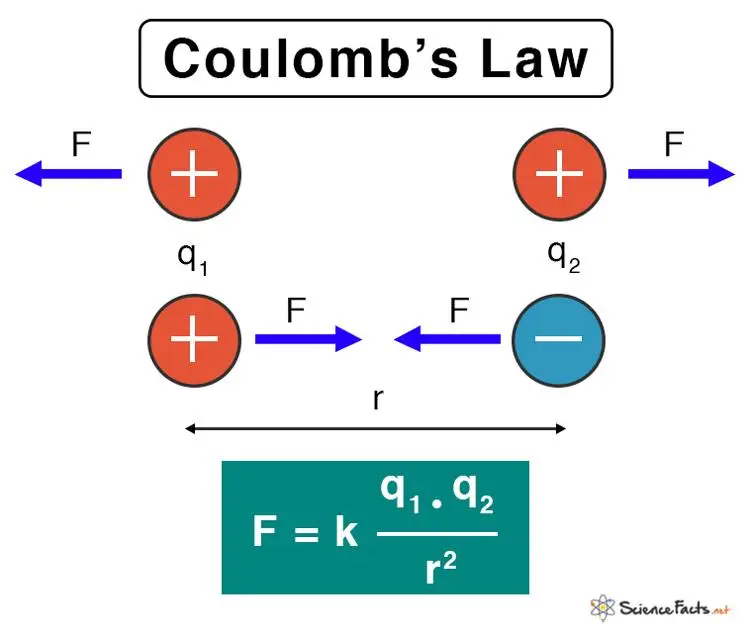
\( \vec{F}=\frac{1}{4\pi\varepsilon_0}\frac{q_1q_2}{r^2}\hat{r} \)
\( q_1 \) = charge on first particle (C)
\( q_2 \) = charge on second particle (C)
\( r \) = distance between charges (m)
\( \varepsilon_0 \) = permittivity of free space (C^2 N^-1 m^-2)
Lorem Ipsum is simply dummy text of the printing and typesetting industry. Lorem Ipsum has been the industry's standard dummy text ever since the 1500s, when an unknown printer took a galley of type and scrambled it to make a type specimen book.
Electrostatic force between two point charges separated by distance \( r \): \( F = \frac{1}{4\pi\varepsilon_0}\frac{q_1 q_2}{r^2} \), acting along the line joining them.